Hi.
Welcome to my blog. I document my adventures in food, travel, and coffee.

Welcome to my blog. I document my adventures in food, travel, and coffee.
Recent Posts from Japan:
Photographs from my meal in Tokyo, Japan at Yukimura on February 2, 2015
Read more...
Photographs from my meal in Tokyo, Japan at Kanda on January 31, 2015
Read more...
Photographs from my meal in Tokyo, Japan at Noma on January 30, 2015
Read more...
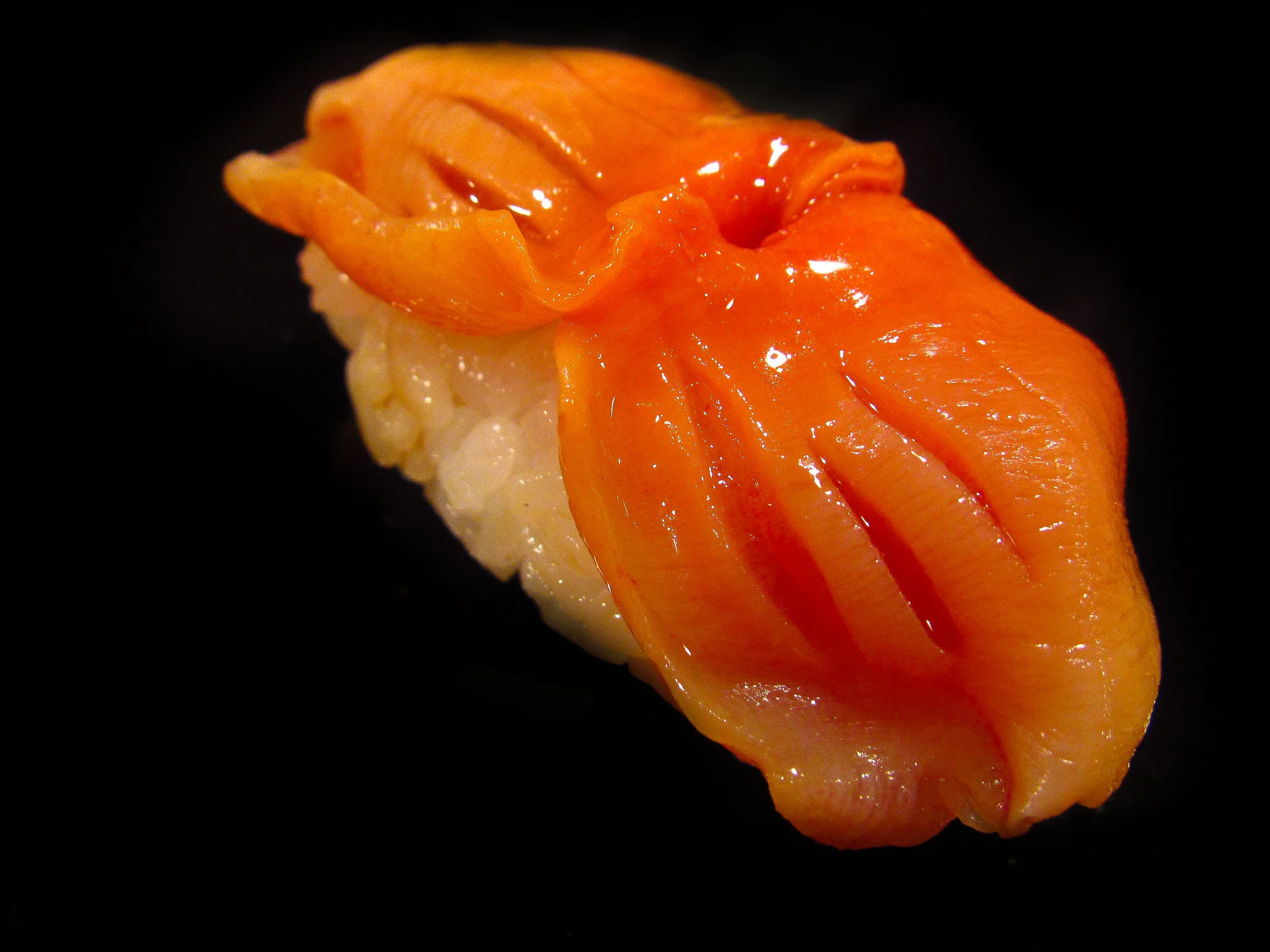
Photographs from my meal in Tokyo, Japan at Sukiyabashi Jiro on January 29, 2015
Read more ...
Photographs from my meal in Tokyo, Japan at Le Château de Joël Robuchon on January 27, 2015
Read more...
Photographs from my meal in Japan , Tokyo at Sukiyabashi Jiro on October 9 , 2012.
Read more...
Photographs from my meal in Japan , Tokyo at Ishikawa on October 6 , 2012.
Read more...
Photographs from my meal in Japan , Tokyo at Quintessence on October 5 , 2012.
Photographs from my meal in Tokyo, Japan at Sushi Yoshitake on October 4, 2012
Read more...
The 7-seat Tapas Molecular Bar in the sky lobby of the Mandarin Oriental Tokyo is the home of chef Jeff Ramsey, formerly of Minibar in Washington D.C. My first meal in 2008, while delicious, featured many of the same dishes featured at Minibar. I think a lot of this was due to the newness of the restaurant and the difficulty in finding its place. It's no easy task to integrate new molecular techniques with traditional Japanese cuisine. However now, two years later, this restaurant has really found its niche in its surroundings and thoroughly impressed me with innovative, delicious, and really fun cuisine. One aspect of the Molecular Bar that makes the experience so fun is its chefs. Instead of creating an environment in which interactivity is passive-aggressively shunned, chef Ramsey and his team explained the back story of each dish and how it related to Japanese culture. This was particularly crucial for the nostaligic dishes as many of the diners did not grow up in Japan. Questions were encouraged, and frankly, this in-depth understanding of the food I was eating really added another dimension to the meal's enjoyment. Not only did I learn a tremendous amount about the food and its preparation, but I felt like I was eating a story with each course.
It wasn't until I visited Japan that I truly liked tempura. Outside of Japan, tempura batter is thick and greasy -- often soggy and wet -- making this deep-fried food taste more like sloppy, oily leftovers. I can't begin to count the number of times I've tasted shrimp tempura and had the plump tempura shell separate from the shellfish, or a piece of broccoli tempura that oozes fat like a sponge wringing out water. Most of the time, especially in the US, tempura is fried food gone very wrong.
At Ten-ichi, tempura is light and fluffy. Each piece of fish or vegetable is individually flash-fried at such a high temperature that the oil barely has little chance to penetrate the food. The batter is thin and weightless, completely integrating with the food: it would be nearly impossible to separate it.
Over the past decade, Roppongi has become the center for Tokyo's nightlife. Full of bars and restaurants, Roppongi is loud, bright, and full of things to do. In contrast, nestled high on one of its hills, is a small oasis named Takamura. Takamura, built over sixty years ago, is a Japanese kaiseki restaurant serving private dinners in one of its eight rooms. The service, as well as the food, are exceptional. The architecture is traditional: wooden construction with rice paper doors and tatami mats. Diners are greeted at the door and taken to their room. The space is small and cosy, however despite the thin walls and presence of other diners, it would be hard to be convinced of their existence.
The table is a modified floor-seating arrangement with a two-foot depression into the floor. This means diners can sit at floor level without sitting uncomfortably with their legs crossed, like sitting in a chair. Underneath the table is a heated floor; so on cold winter nights with the wind howling and garden chimes softly clanging everybody inside is warm and comfortable.
Beige Tokyo, Alain Ducasse's Tokyo outpost, is located at the top of the Chanel flagship store in Ginza. The floor to ceiling windows are framed with thick black borders, much like a pair of Chanel thick-rimmed glasses. The space is decorated in beige tones bringing an element of warmth to the otherwise stark atmosphere. Waiters and waitresses quietly whisk about in custom-fitted black suits. The sleek and stylish restaurant, designed by Karl Lagerfeld, is a must-visit for fashion-conscious diners. Beige is essentially a restaurant by a high-end designer in collaboration with Alain Ducasse. The food is also pretty good. The menu highlights traditional French ingredients, most of which are flown in from Europe. The dishes read in Alain Ducasse style with a simple ingredient made bold by a bombardment of luxurious accoutrements. The restaurant's dishes are consistent and familiar.
I'd always thought of ramen as a street stall kind of food. In Fukuoka, Yatai (street stalls) line crowded streets with nothing more than a short hanging curtain separating the stall from busy pedestrians. There's definitely something romantic about trying one of these ramen stalls, particularly in the winter where the hot steam from the central pot keeps the crowded of huddled diners warm. But frankly, the backless wooden stalls get uncomfortable after awhile as the sound of traffic becomes less charming and more annoying. There's an increasing trend in Tokyo to take traditional street food, enhance it, and escalate it to the fine dining level. That's exactly what Mist does. Located in on the third floor of Omotesando Hills, Mist occupies a small restaurant space paneled with granite and wood. It's very modern. Behind the stainless steel kitchen lies scales and thermometers ensuring that every step along the way, from shaping the noodles to plating the soup, results in perfection.
It's fairly easy to find good sushi in Tokyo, but rather difficult to find exceptional sushi. Even the bento boxes at Tokyo Station, which makes for a great accompaniment on a long Shinkansen ride, are of very high quality -- much higher than the average sushi quality in New York. But truly out of the ordinary sushi -- the rare combination of perfect textures, temperatures, and flavors -- is a rare commodity. There are only a handful of places at this level. Sushi Kanesaka is one of them. Located in the basement floor of a nondescript building in Ginza, Sushi Kanesaka is unassuming. Its thirty-something year old chef, Shinji Kanesaka, offers no indication from talking with him that he holds two Michelin stars. He is both humble and friendly.
The restaurant only serves omakase. However Chef Kanesaka's palette seems to prefer shellfish, which is what I would mostly order anyway. What made this restaurant so special aside from the freshness of ingredients was the fish selection: I wouldn't have ordered anything different from what was served. Chef Shinji Kanesaka read my mind.
Sushi is my favorite food. There's nothing so satisfying as a slice of the freshest fish imaginable just barely brushed with soy sauce -- or dusted with a pinch of salt -- atop a small bed of warm rice. Omakase is a great way to enjoy this experience because it introduces the elements of surprise as well as the chef's knowledge of the day's best catch. But how does the chef always know what I want? Sometimes an elaborate sushi meal is too much; sometimes I want to choose a handful fish I'm craving and eat lightly. Sometimes, ordering a la carte at a sushi counter is the way to go. Kyubei sushi, in Ginza, is perfect for diners who want to chose their own fish. The relatively informal atmosphere in combination with ease of getting a reservation at one of its five locations throughout the city makes it a good option for a last-minute dinner decision. Besides, who can object to a meal of eight pieces of unimaginably fresh sea urchin sushi? (I've done it before.) The fish at Kyubei is extremely fresh and the pricing much more reasonable than Sukiyabashi Jiro.
My first visit to Sukiyabashi two years ago was one of the best sushi meals of my life. The meal's beauty lies in its apparent simplicity: just rice and fish. Of course this is deceiving. The exquisite sushi is the amalgam of impeccable ingredients and skill, from the hand-selected blend of rice and its meticulous steaming, to the exacting ratio of fish to rice and the timing with which it's served. Even the luke-warm temperature of the rice and its precise grain count per piece, as well as the sushi's position on the plate, is no accident. Chef Jiro Ono, Japanese living legend, is perhaps the world's greatest sushi chef. The atmosphere of Sukiyabashi Jiro seemed more relaxed and comfortable than the last time. While both the chef and his son were friendly and engaging in 2008 food photography -- no matter how subtle -- seemed to make them a bit uncomfortable. Two years later and chef Ono was smiling and welcoming photos. The sushi bar also seemed to have more foreigners. During my last meal I was the only foreigner at the table. Considering my meal in 2010 was on the exact same day as in 2008, it's unlikely a seasonal difference. This is probably due to its Michelin 3* rating permeating out, as well as the increase in internet publicity.
My last meal at Pierre Gagnaire, Paris was a roller coaster. Lots of ups and downs and by the end of service I was left holding on to my chair in confusion. Any great restaurant has to take risks in the kitchen to achieve something great. But my original experiences were like a lottery, and after three meals at Gagnaire Paris, I kept losing. Pierre Gagnaire Tokyo, in some ways, was the complete opposite. There were few risks. Everything was consistent. This is good in the sense that no single course was particularly disappointing; bad, however, that nothing was exceptional. Exceptional cuisine balance risk-taking and spontaneity with consistency, and it's no easy task. My meal here was an extremely toned-down version of my meal in Paris.
The New York Grill and its adjacent bar sits atop the 52th floor of the Park Hyatt in Nishishinjuku, Tokyo. This hotel, and in particular its rooftop bar, was made famous by the 2003 movie Lost in Translation. As in the movie the bar, with its somber spot lighting de-emphasizing the interior and emphasizing the breathtaking views of Tokyo, has to it an ethereal quality where visitors are at awe by the twinkling panorama while simultaneously in disbelief they are actually there. Or maybe that's just the jetlag. The restaurant, paneled with art deco paintings by Valerio Adami, has gone through several chefs over the last five years, the most recent of whom, Nadine Waechter Moreno, took over as Chef de Cuisine in August of 2010. My experiences at the Park Hyatt were under the previous chef, Stefan Moerth.
Why eat French food in Tokyo? Because it's usually better than in France! Located on the second floor of its own two-story building in Ginza, L'Osier perches over the surrounding street lined with designer stores and Tokyo's fashion-savvy shoppers. L'Osier is both style and substance, however; its plates both visually stunning and delicious. I had a meal here in 2006 and never got around to posting it. But I have such strong and positive memories about my experience here that it would be an injustice not to share it. I'm going to post what I remember based on my notes. I ate here before Michelin came to Tokyo and rated this restaurant three stars. It's interesting to see how this restaurant seems to have only gotten better since then.
The simplicity and minimalism of Japanese cuisine never cease to amaze me. Particularly with traditional kaiseki, sauces and spices practically don't exist. Instead of flavoring the ingredients in a dish with external condiments, ingredients are chosen for their own intrinsic flavors. This ingredient-focused approach took a bit of getting used to; in fact the first time I tried kaiseki, I didn't like it. I thought the flavors were dull, repetitive, and boring. But the more I ate it and the longer I spent in Japan, the more I began to appreciate it. My barometer of flavor reset. Instead of loud spicy Thai cuisine full of spices and herbs, or very sweet and sticky Shanghainese cusine, Kaiseki lies flat in the middle: nothing too sweet, salty, or sour. It is a cuisine of modesty and humility where the natural flavors of the ingredients are put on a pedestal to shine.
Traditional amber wood and handmade pottery carried by waitresses in kimonos contrast against floor-to-ceiling windows and granite slabs overlooking one of the most impressive restaurant views in the city. Such an explicit juxtaposition of the traditional with the modern -- two concepts whose constant interplay largely defines Japanese culture -- contributes to Kozue's uniqueness. The dishes themselves are very traditional in flavor -- there are no "twists" -- but their presentation and the finesse with which the waitresses explain their components make this type of cuisine extremely accessible to westerners. The views from the restaurant are phenomenal. Perched on the 40th floor of the Park Hyatt, Kozue faces west. On a clear day one can see as far as Mount Fuji. The restaurant's policy is not to guarantee window tables -- even for hotel guests -- but I think it's worth waiting around for the next window table to become available.
Signature is the home of chef Olivier Rodriguez who formerly worked at the Tokyo location of Enoteca Pinchiorri. His menu read straightforward with two tasting menus and an à la carte section. The tasting menu seemed like a little much since my body still thought it was seven in the morning. So we ordered a few of dishes from the à la carte section and decided to split them. Well, maybe we ordered a lot of dishes. The exorbitant prices are justified (somewhat) by the exquisite view. We were lucky enough to have a window table, and maybe it was the jetlag but I felt like I was eating on the edge of a cliff. My eyes were in awe of the view: thousands of red lights flickering atop the Tokyo skyline.
The last time I was in Japan I didn't care much for coffee. It wasn't until a revelatory experience at Joe's in the summer of 2009 that I started to like it. Rather, become a bit obsessed. And so when I visited Tokyo this December I was determined to explore the city's cafe offerings. I was particularly interested in how Japanese precision and general distaste for sourness would translate to espresso. I started with a list of twenty-five cafes that my friend and barista Yukimim put together for me. I went to all of them (in four days!). Of all the cafes I visited, one place really stood out as extraordinary: Bear Pond Espresso. Bear Pond is the home of barista-owner Katsu Tanaka, an 18-year New York resident who recently moved back to Tokyo and opened shop. Tanaka -- who doesn't allow another's hands to touch the espresso machine in fear of lack of consistency -- closes the doors to Bear Pond at 2pm. "After 2pm," he explains, "too many people come and I cannot make consistent coffee." Bear Pond's shots, really a pseudonym for Tanako's since he is the only barista, are remarkably consistent.
It's easy to walk down the quiet residential streets of Jingu-mae and miss this restaurant: it's in the basement of an apartment building with no signage. But what Esaki lacks in street-level visibility it makes up for in flavor. It's modern take on traditional kaiseki -- with all locally sourced organic ingredients -- highlights the best of Japanese cuisine yet incorporates a number of modern twists that make for a more interesting, fresh experience. The menu, full of kanji beyond my understanding, proved challenging -- the waitress patiently helped me to decipher the words I didn't know, and even brought paper and pen to take notes. At this 3-starred Michelin restaurant, things suddenly felt a lot more relaxed and comfortable.
I always thought two parents were more than enough. But after visiting Sukiyabashi Jiro in Ginza, Tokyo, I will be returning with adoption papers. Chef Jiro Ono has been recognized by the Japanese government as a national treasure and “modern master” for his contributions to Japanese cuisine. He has received three Michelin stars. The awards an accolades for this masterful chef are endless. And to believe he is over 80 years old.
Chef Ono’s dishes are simple and straight forward: the freshest fish imaginable, warm carefully selected and cooked rice, deft knife work, and a collection of wise and sarcastic jokes. He is very serious. But unlike Masa, he was faster to crack a smile. He couldn’t stop smirking at how I took a picture of each piece of sushi and even offered to pose; though, his sharp sushi knife was a forceful deterrent. He has a funny sense of humor and is full of clever quips; my limited Japanese only understood the surface. He asked if we had any allergies or restrictions. We made it very clear that we eat absolutely everything.
Chef Yamamoto Seiji (山本征治) opened RyuGin in December 2003 at the young age of thirty three. Before that he had worked under Koyama Hirohisa (小山裕久) at Aoyagi (青柳) for ten years, channeling his talent for cooking the highest quality ingredients flawlessly. In theory, the highest quality ingredients combined with impeccable cooking should guarantee an unforgettable meal. At least that's what I thought. The restaurant is located on a small side street in Roppongi. The area used to be a bit seedy but after the construction of Roppongi Hills (六本木ヒルズ) completed in 2003, the neighborhood perked up. Now it is known for its sophisticated nightlife including a handful burgeoning restaurants eager to collect their stars. Yet despite being in such a lively neighborhood, RyuGin remains humble and quiet having just under twenty seats.
The service at RyuGin, like the service at nearly every other fine dining establishment in the city, was flawless and graceful. The staff spoke with tremendous knowledge about the menu yet remained impressively humble. The stage was set for a fantastic meal. Everything was ready, that is, except the food.
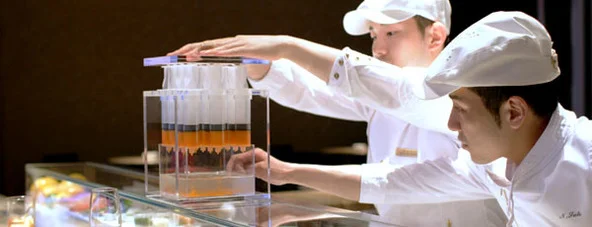
With molecular gastronomy taking the world by storm it was only a matter of time before it crossed the pacific. Located in the sky lobby of the Mandarin Oriental Tokyo, the Tapas Molecular Bar is Japan’s introduction to this innovative and creative cuisine. The interactivity that makes molecular gastronomy so much fun is heightened by the restaurant’s sushi counter seating which holds at most seven guests at a time. The entire evening is filled with conversation between not only dining companions, but with the chefs as well. It is interactive in every respect.
Japan is known for its mix of tradition and technology. I can't tell you how many pictures I've seen of a bullet train passing Mount Fuji with cherry blossoms blooming in the background. This mix of new and old is, what I believe, made the molecular bar so appealing.
It was my mother's first time in Japan. While she was only staying for a short week and a half, the planning for her visit started many months before. I had to create an agenda demonstrating Japan's incredible culinary variety while still making sure she would enjoy, and remember, each meal. If she were to leave Japan thinking the food is anything less than the best in the world, I'd have failed. Kaiseki was going to be a problem. There are just too many places. The number of Michelin starred kaiseki restaurants alone would consume her trip in its entirety; how would I fit in okonomiyaki, teppanaki, yakitori, sukiyaki and shabu shabu? I knew an early morning trip to Tsukiji market was essential, not only for the tuna auction but to show her the abundance of fresh fish that we don't have access to in the US, and the ease with which it can be purchased here. Besides, forget cereal; what better way to start the day than with a small crate of Hokkaido uni.
To complement our visit to Tsukiji, later that night, I made a reservation at Jisaku Tsukiji, a small kaiseki restaurant on the fish market's perimeter. Like most well-known kaiseki houses, diners eat in private rooms. This means two things: the meal will be private, and it will be expensive. Thankfully, this was a once in a lifetime experience.